Ceramides are among the most frequently mentioned ingredients in moisturizers designed to support the skin barrier.
They are often described as essential for healthy skin, and products containing them are commonly marketed for dryness, sensitivity, or barrier repair.
There is a scientific reason for this interest. Ceramides are naturally present in the skin and play an important role in maintaining its protective structure.
However, the importance of ceramides within the skin does not mean that every cream containing them will produce the same results.
Understanding what ceramides do naturally, and what topical formulations can realistically achieve, helps put these claims into perspective.
What Are Ceramides?
Ceramides are a family of lipids, or fat-like molecules, naturally found in the skin.
They are particularly important in the stratum corneum, the outermost layer of the epidermis.
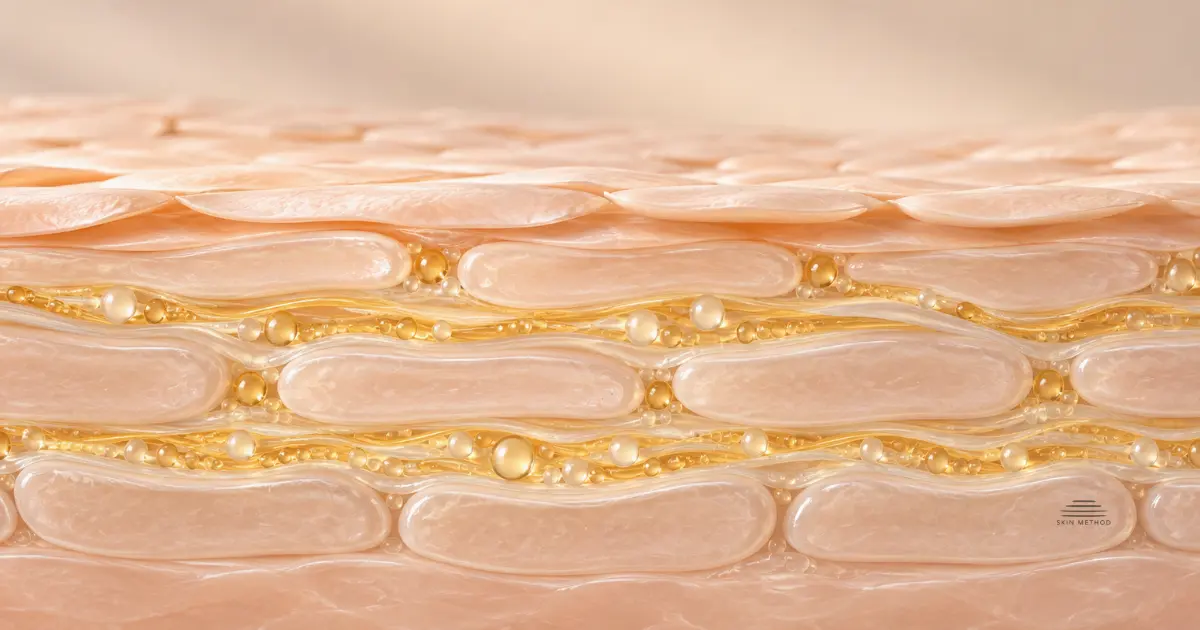
This layer contains flattened skin cells surrounded by an organized mixture of lipids. Ceramides are one of its major lipid components, alongside cholesterol and free fatty acids.
Together, these lipids help form the skin’s protective barrier.
Ceramides are not a single, uniform substance. The skin contains multiple types with different molecular structures.
These differences influence how the lipids organize themselves and contribute to barrier function.
For everyday skincare, the important point is that ceramides are part of the skin’s natural structure rather than simply substances added to make the surface feel softer.
How Do Ceramides Help the Skin Barrier Work?
The stratum corneum is often described using a brick-and-mortar analogy.
The flattened skin cells are compared to bricks, while the lipids surrounding them form the mortar.
Although simplified, this comparison helps explain why the spaces between skin cells matter.
Ceramides, cholesterol, and free fatty acids form highly organized layers between the cells. Their arrangement helps control how easily water and other substances move through the skin.
This organization is essential for limiting excessive water loss and maintaining the barrier’s protective function.
Ceramides contribute to the structure and stability of these lipid layers.
Their molecular characteristics, including chain length and composition, affect how closely the lipids can pack together.
This is one reason ceramides are so important to normal skin-barrier function.
However, they do not work independently.
Cholesterol and free fatty acids are also necessary components of the lipid system, and the balance between these substances influences how the barrier performs.
As explained in What Your Skin Barrier Actually Does, the skin’s protective function depends on several coordinated structures and processes.
Ceramides are an important part of that system.
What Happens When Skin Ceramides Are Altered?
Changes in the amount, type, or organization of ceramides can affect the properties of the skin barrier.
Research has identified alterations in stratum-corneum ceramides in certain conditions associated with impaired barrier function.
Atopic dermatitis is one well-studied example.
In affected skin, researchers have observed differences in ceramide composition, including changes in the lengths of certain lipid molecules and the way the lipid layers are organized.
These changes are associated with increased barrier permeability and water loss.
However, dry or uncomfortable skin does not always indicate a ceramide deficiency.
Skin dryness can develop through several interacting factors, including environmental conditions, cleansing practices, age-related changes, and underlying skin conditions.
Similarly, changes in ceramides may occur alongside inflammation and other biological processes.
The relationship is more complex than simply having too few ceramides.
Understanding this distinction helps avoid the assumption that every episode of dryness requires a ceramide-specific product.
What Can Topical Ceramides Actually Do?
Because ceramides are important components of the natural skin barrier, they are frequently included in moisturizers intended to support dry or barrier-impaired skin.
Research has shown that some ceramide-containing formulations can improve skin hydration and certain measures of barrier function.
Clinical studies involving people with atopic dermatitis have also reported improvements in dryness and disease-related symptoms with ceramide-containing moisturizers.
These findings support their usefulness as moisturizing ingredients.
However, an important question remains: are ceramide moisturizers consistently better than moisturizers without added ceramides?
The available evidence does not establish that they are.
A 2023 systematic review and meta-analysis found a small advantage for ceramide-containing moisturizers in one measure of atopic dermatitis severity, but no statistically significant advantage in transepidermal water loss compared with other moisturizers.
The studies also differed in their formulations and methods, which limits how broadly the findings can be applied.
This does not diminish the biological importance of ceramides.
It means that a moisturizer can support hydration and barrier function through several different mechanisms.
A well-formulated product without added ceramides may still perform very effectively.
Likewise, the presence of ceramides does not guarantee that a product will outperform other moisturizers.
Why Does the Formulation Matter?
Ceramides are not always easy ingredients to formulate effectively.
Their physical properties can make them difficult to incorporate and organize within a finished product.
How they are dispersed, combined with other ingredients, and arranged within the formulation can influence their performance.
This is particularly relevant because the skin’s natural barrier relies on an organized mixture of ceramides, cholesterol, and free fatty acids.
Research has investigated combinations of these lipids and found that their relative proportions can influence barrier recovery under experimental conditions.
However, these findings do not establish one ideal ratio for every moisturizer.
The most suitable lipid composition may depend on the formulation, the condition of the skin, and the purpose of the product.
It is also important to distinguish the natural proportions of lipids within the skin from the proportions used in a manufactured cream.
A formula that includes several barrier-related lipids is not automatically equivalent to the skin’s own lipid structure.
For consumers, this creates a practical limitation.
An ingredient list can identify the presence of ceramides, cholesterol, or fatty acids, but it cannot reveal how effectively those ingredients are organized within the product.
The finished formulation matters more than any single ingredient name.
Are All Ceramides in Skincare the Same?
Skincare ingredient lists may identify ceramides using names such as Ceramide NP, Ceramide AP, or Ceramide EOP.
These names refer to different members of the ceramide family.
Their molecular structures differ, and these differences can be relevant to skin-barrier biology.
However, the presence of one particular ceramide does not automatically make a moisturizer superior.
Similarly, a product containing several named ceramides is not necessarily more effective than one containing fewer.
The amount of each ingredient, the surrounding formulation, and the product’s overall performance all matter.
Ceramide names can help identify what a product contains, but they are not a reliable way to rank moisturizers.
This is an important distinction in a skincare market where ingredient counts are often used as a measure of product quality.
More ingredients do not necessarily mean better results.
Do You Need a Ceramide Moisturizer?
Ceramide-containing moisturizers can be useful, particularly when the skin is dry or its barrier function is impaired.
However, they are not essential for everyone.
A moisturizer can support the skin through several complementary functions.
Humectants help maintain hydration. Emollients improve softness and surface feel. Occlusive ingredients help reduce water loss.
Some formulations also include lipids intended to support the skin’s barrier environment.
A product does not need to contain every possible category of ingredient to be effective.
If an existing moisturizer keeps the skin comfortable and adequately hydrated, there may be little reason to replace it simply because another product advertises ceramides.
For persistent dryness or a diagnosed skin condition, the most appropriate moisturizer may depend on individual needs and professional guidance.
As discussed in Moisturizer: What It Should Actually Do, the value of a skincare product lies in how well it supports the skin’s needs.
The Bottom Line
Ceramides are essential components of the skin’s natural barrier.
Together with cholesterol and free fatty acids, they help from the organized lipid layers that limit water loss and contribute to the skin’s protective function.
Ceramide-containing moisturizers can support hydration and barrier-related outcomes, particularly in some forms of dry or barrier-impaired skin.
However, research does not show that every ceramide moisturizer is superior to other well-formulated products.
The type and organization of lipids, the complete formulation, and the condition of the skin all influence performance.
Ceramides matter greatly to the skin. Whether adding them makes a particular moisturizer more effective depends on how the product is formulated and how well it meets the skin’s needs.
This article is intended for educational purposes only and is not medical advice. Skin needs and responses vary, and persistent skin concerns should be discussed with a qualified healthcare professional.