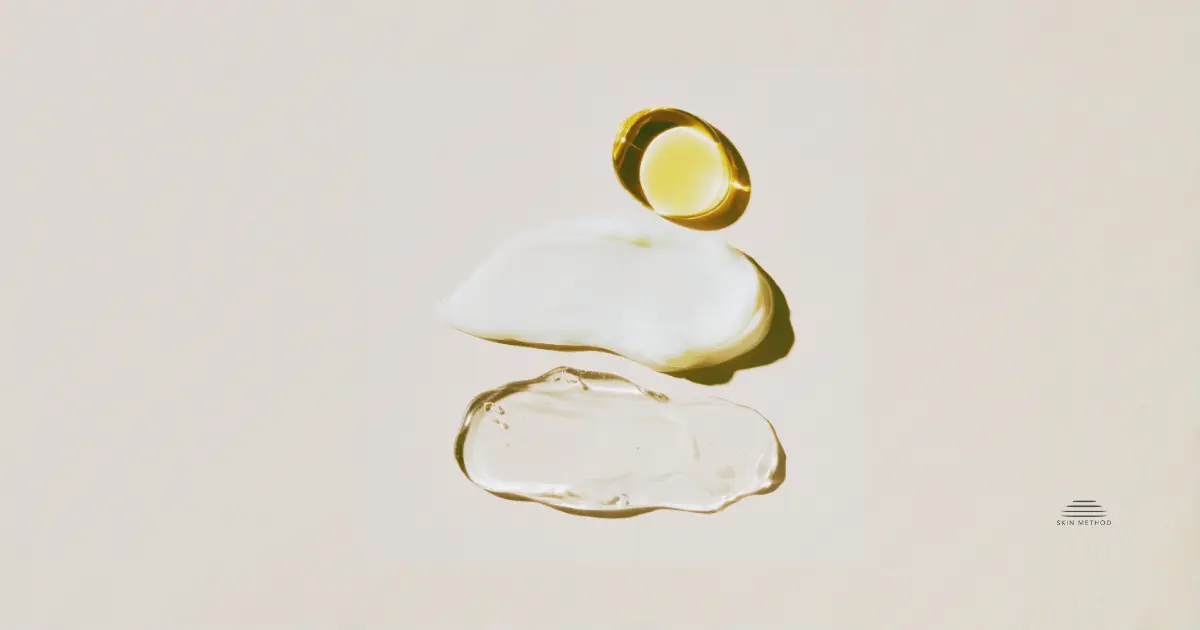
Some skincare products feel rich and creamy. Others feel light, watery, silky, sticky, oily, or almost weightless. Some disappear quickly after application, while others leave a noticeable layer on the skin.
These differences can strongly influence how we judge a product. A rich cream may feel more moisturizing. A lightweight serum may seem as though it absorbs more deeply. A product that leaves residue may feel less sophisticated or less effective.
But texture tells us primarily about how a formulation behaves and feels during use. It does not, by itself, tell us how well the product performs its intended biological function.
Understanding that distinction can make it easier to evaluate skincare products without ignoring something that genuinely matters: whether you actually like using them.
What Do We Mean by Texture in Skincare?
Texture is more than whether a product is thick or thin.
It includes the whole sensory experience of applying a product: how easily it spreads, how much slip it has, how quickly its initial wetness or oiliness changes, and what remains on the skin afterward.
A product might feel:
- watery or gel-like
- creamy or buttery
- oily or waxy
- silky or slippery
- sticky or tacky
- rich or lightweight
Its finish can also matter. Some products leave the skin feeling soft or smooth. Others leave a noticeable film, shine, tackiness, or very little sensation at all.
These characteristics are part of the formulation. They are not simply decoration added after the important ingredients have been chosen.
Where Does a Product’s Texture Come From?
A skincare product usually contains ingredients performing many different jobs.
Water, oils, waxes, emulsifiers, humectants, thickeners, silicones, powders, and other ingredients can all influence how a formulation spreads and feels. The amounts used, how ingredients are combined, and the structure of the finished formula matter as well.
This is one reason an ingredient list should not be divided too quickly into “important” active ingredients and everything else. As discussed in Why Lotions Need More Than Active Ingredients, the supporting ingredients help create the finished product that can actually be applied, spread, preserved, and used comfortably.
Texture therefore usually cannot be explained by finding one familiar ingredient on the label.
Two products can contain some of the same recognizable ingredients and still feel very different. Likewise, products with very different ingredient lists may produce a surprisingly similar sensory experience.
Why Do Some Products Feel Rich While Others Feel Light?
We often associate richness with nourishment or moisturization.
There is some understandable logic behind that impression. Oils, waxes, and other materials that remain on the skin can contribute both to a richer sensory experience and to useful functions such as reducing water loss. You can read more about these different materials in Oils, Butters, and Waxes: What Each Actually Does.
But the relationship is not simple enough to conclude that a thicker or heavier product must be more effective.
A lightweight moisturizer can still contain ingredients selected to support hydration and reduce water loss. A rich cream may feel protective and comfortable without necessarily being the best choice for every person’s skin or every situation.
Thickness, richness, and biological effect are related to formulation, but they are not interchangeable measures.
This is why it helps to judge a moisturizer first by the job it needs to perform, rather than by how substantial it feels. Moisturizer: What It Should Actually Do looks at that distinction in more detail.
What Does “Absorbs Quickly” Actually Mean?
We often describe a product as having “absorbed” when we can no longer feel much of it on the skin.
You may even hear someone say that their skin “drank it up”.
What we are noticing, however, is a change in the product’s sensory presence. That does not necessarily mean the entire formulation has moved deep into the skin.
After application, several things can happen. Water and other volatile components may evaporate. The product spreads into a thinner layer. Some ingredients interact with the outer layers of the skin, while others remain primarily at or near the surface. The feel of the product changes as these processes occur.
So a product that seems to disappear quickly has not necessarily penetrated more deeply than one that remains noticeable.
Skin penetration is its own subject and depends on the properties of the ingredient, the formulation, and the skin itself.
The useful distinction is simple:
How quickly you stop feeling a product is not a direct measure of how deeply its ingredients have traveled.
Why Residue Is Not Automatically a Bad Thing
The opposite assumption can happen with products that remain noticeable.
If a moisturizer leaves a film, we may assume that it has failed to absorb. If a product feels oily, we may think it is simply sitting uselessly on the surface.
Sometimes, however, remaining at or near the skin surface is part of what an ingredient or product is supposed to do.
A moisturizer may include ingredients that form a layer that helps reduce water loss. Sunscreens need to form an appropriate film over the skin to provide their intended protection.
A product can perform a useful function and still feel too greasy, sticky, heavy, or uncomfortable for you. Sensory preference is a legitimate part of choosing skincare.
The important point is that a noticeable residue does not automatically mean a product is poorly formulated or ineffective.
Texture Can Affect How Well a Product Works in Real Life
If texture does not directly tell us biological effectiveness, does it really matter?
Very much.
Imagine a sunscreen that provides excellent protection when applied correctly but feels so heavy that you consistently use much less than intended. Or a moisturizer that suits your skin well but feels so unpleasant that you rarely reach for it.
The formulation may be capable of doing its job, but your experience of using it has changed how it performs in your actual routine.
Texture can influence how easily a product spreads, how much you apply, whether it layers comfortably with other products, whether you are willing to reapply it, and whether you continue using it at all.
This is one reason cosmetic elegance matters. A pleasant texture does not prove that a product is more biologically effective. But making a product comfortable and practical to use can make it easier for people to use it as intended.
That is a real function of formulation.
Texture Also Shapes What We Expect From a Product
Sensory experience can influence our judgement before we know very much about what a product is actually doing.
A thick cream can feel nourishing.
A silky serum can feel sophisticated.
A lightweight product can seem gentle.
A tingling product can feel active.
A product that disappears quickly can seem as though it has penetrated deeply.
These impressions are understandable. We naturally use sensory information to interpret what we experience.
The problem comes when the sensation becomes evidence for a claim it cannot actually establish.
A luxurious texture does not prove that a formula will produce better skin results. Tingling does not prove that an active ingredient is working. A heavy product is not necessarily more moisturizing simply because we can feel it for longer.
Texture tells us something important about the experience of the formulation. Other questions are needed to understand what the formulation can actually do.
A More Useful Way to Think About Product Feel
Instead of asking whether a product feels effective, it can help to separate two questions:
Does this product perform the job I need it to perform?
Is it comfortable and practical enough for me to use as intended?
Both questions matter.
The first keeps sensory impressions from becoming a substitute for understanding product function.
The second recognizes that skincare happens in real life. A product that feels unpleasant, layers badly, leaves a finish you dislike, or is difficult to use consistently may simply be a poor fit for you, even if there is nothing inherently wrong with the formulation.
Texture is therefore neither superficial nor proof of effectiveness.
It is one part of how a complete skincare formula works for the person using it.
The Bottom Line
Texture changes how we experience skincare because it affects spread, slip, richness, residue, finish, and the way a product behaves during everyday use.
Those sensations can also shape our expectations. Rich can feel more moisturizing. Lightweight can feel more absorbent. A disappearing product can seem more effective than one that leaves a film.
But feel alone cannot tell us what a product is doing biologically.
A better approach is to consider function and sensory experience separately, then bring them back together. The product should be able to perform the job you need from it, while also being comfortable and practical enough that you can use it appropriately.
That makes texture important for a more useful reason: not because it proves that skincare is working, but because it helps determine how the formulation fits into real life.
This article is intended for educational purposes only and is not medical advice. Skin needs and responses vary, and persistent skin concerns should be discussed with a qualified healthcare professional.