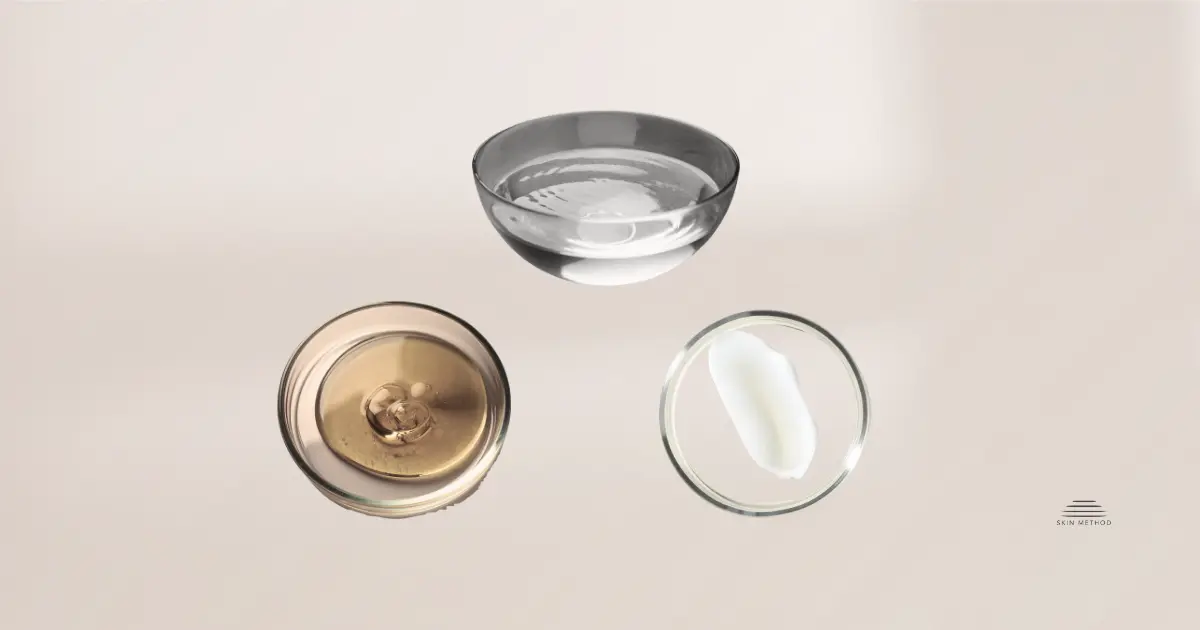
Oil and water do not naturally stay mixed.
If you combine them in a container and shake it, the oil may temporarily break into small droplets and spread through the water. Leave the mixture alone, however, and the two begin separating again.
This creates an interesting challenge for skincare formulation. Many lotions and creams contain both water-based and oil-based ingredients, yet we expect the product to remain smooth and consistent rather than separating into layers.
Emulsifiers are one of the tools formulators use to make that possible.
Understanding what they do also helps explain why ingredients that receive little attention on the front of a skincare package can still be essential to the finished product.
What Is an Emulsion?
An emulsion is a mixture in which small droplets of one liquid are dispersed throughout another liquid that would not normally mix with it.
Many lotions and creams are emulsions because they contain both an oil phase and a water phase.
In one common type of emulsion, small droplets of oil are dispersed through a continuous water phase. In another, water droplets are dispersed through an oil phase. Formulators can use different structures depending on what they want the finished product to do.
You do not need to identify the type of emulsion every time you use a moisturizer. The important idea is simpler: the oil and water have been organized into a structure that allows them to exist together in a usable product.
Why Do Oil and Water Separate?
Water molecules interact readily with other water molecules. Oils have different chemical properties and do not interact with water in the same way.
Mixing oil and water can temporarily break one of them into small droplets and distribute those droplets throughout the other. But simply creating the droplets does not mean they will remain that way. Over time, the droplets can come together and the phases can separate again.
So a formulator has two related challenges: creating the dispersed structure and helping it remain sufficiently stable.
This is where emulsifiers become important.
What Does an Emulsifier Actually Do?
Emulsifier molecules contain regions that interact differently with water and oil. This allows them to position themselves at the boundary between the two.
By acting at this boundary, emulsifiers make it easier to create small droplets of one phase within the other and help reduce the tendency of those droplets to come back together.
This is more accurate than simply saying that an emulsifier “makes oil and water mix”.
The oil and water have not suddenly become naturally compatible. Instead, the emulsifier helps create and maintain an organized structure in which one can remain dispersed through the other.
In formulation science, part of this involves reducing the tension at the interface between the oil and water phases. The practical result is this: emulsifiers help make stable emulsions possible.
An Emulsifier Does Not Work Alone
It would be convenient if making a lotion were simply a matter of combining water, oil, and an emulsifier.
In practice, the finished product depends on much more.
The types and amounts of oils matter. The emulsifier or combination of emulsifiers matters. Thickeners and other stabilizing ingredients help build the desired structure. Temperature, mixing, pH, manufacturing conditions, and the other ingredients in the formula can all affect how the system behaves.
This is one reason skincare products contain ingredients that may seem less interesting than the ingredients highlighted on the package. As discussed in Why Lotions Need More Than Active Ingredients, a finished product needs more than ingredients associated with a particular skin benefit. It also needs the structure that allows those ingredients to exist together in a usable formulation.
An emulsifier is part of that larger system.
Why Do Emulsifiers Matter to the Finished Product?
When you pump a lotion from a bottle, you probably expect each application to have roughly the same appearance and consistency.
You do not expect to receive mostly watery liquid one day and a layer of oil the next.
Maintaining the intended physical structure of an emulsion helps make that consistency possible.
Emulsifiers therefore contribute to something we often take for granted: a lotion or cream that remains a coherent product rather than separating into its different phases.
That does not mean an emulsifier alone determines whether a skincare product will remain stable throughout its expected life. Product stability depends on the complete formulation, packaging, manufacturing process, storage conditions, and other factors. Physical emulsion stability is only one part of the larger picture.
Still, without an appropriate emulsifying system, many familiar skincare products could not maintain the structure we expect from them.
Do Emulsifiers Affect How a Product Feels
They can.
The emulsifier system is one of the many formulation choices that can influence thickness, spread, slip, residue, and the way a product feels after application.
But you generally cannot look at one emulsifier on an ingredient list and predict whether the finished product will feel rich, lightweight, silky, or greasy.
Oils, waxes, humectants, thickeners, silicones, powders, and many other formulation choices can contribute to the sensory experience.
This is why texture is best understood as a property of the complete formula rather than the result of one ingredient. In Why Texture Changes How We Experience Skincare Products, we looked more closely at how spread, residue, richness, and other sensory characteristics influence the way we experience a product.
Emulsifiers can contribute to that experience, but they do not determine it by themselves.
Are All Emulsifiers the Same?
No.
Different emulsifiers have different properties and may work better under different formulation conditions. Formulators can also use more than one emulsifier or combine emulsifiers with other ingredients that help stabilize the system.
This is another reason ingredient-list reading has limits.
Recognizing the name of an emulsifier may tell you something about one ingredient’s likely function. It does not tell you everything about how the complete formulation has been designed or how well the product will perform.
The useful skill is not memorizing a long list of emulsifier names. It is understanding why this type of ingredient might be present in the first place.
Does Every Skincare Product Need an Emulsifier?
No.
Emulsifiers are useful when a formulation needs to bring together phases that would not otherwise remain dispersed, such as oil and water.
A product made entirely from oils does not need an emulsifier simply because it is a skincare product. A water-based product may also have no need for an oil-and-water emulsifying system.
Whether an emulsifier is needed depends on the structure of the particular formulation.
This is a useful way to think about skincare ingredients more generally. Instead of asking whether every good product should contain a particular type of ingredient, ask:
What does this formulation need that ingredient to do?
What Happens When an Emulsion Breaks?
Sometimes an emulsion loses the physical structure it was designed to maintain.
Visible separation can be one sign. You might see an oily layer, watery liquid separating from a cream, or a substantial change in consistency.
However, not every small change in texture means an emulsion has broken. Products can change in appearance or feel for different reasons, and evaluating product stability involves much more than simply looking at it.
For formulators, preventing unwanted separation is part of designing and testing an emulsion appropriately.
For someone using the product, the important point is that the smooth lotion or cream in the container is not simply oil and water that happen to be sitting together. Its structure has been deliberately created and needs to remain sufficiently stable for the product to function as needed.
A Better Way to Think About Emulsifiers
Ingredient lists often direct our attention toward ingredients associated with visible skin benefits.
Vitamin C sounds important. Ceramides sound useful. Niacinamide may be prominently advertised on the package.
An emulsifier is much less likely to be the reason someone buys the product.
But that does not make its role unimportant.
One of the central ideas behind Ingredient Literacy: A Better Way to Understand Skincare Products is that an ingredient becomes more understandable when we ask what function it performs within the formulation.
For an emulsifier, that function is largely structural. It helps a formulator create and maintain a product containing components that would otherwise tend to separate.
Once we understand that job, an unfamiliar ingredient name becomes less mysterious.
The Bottom Line
Many familiar skincare products contain both water-based and oil-based materials. Because oil and water do not naturally remain mixed, creating a stable lotion or cream requires more than simply combining them.
Emulsifiers help create and maintain an emulsion by working at the boundary between the oil and water phases and helping one remain dispersed through the other.
They do not work alone, and they do not single-handedly determine a product’s texture, stability, effectiveness, or suitability for your skin. They perform one important job within a larger formulation.
That is also why understanding skincare ingredients is easier when we look beyond which ingredients sound impressive and ask a more useful question:
What job does this ingredient need to do in the finished product?
This article is intended for educational purposes only and is not medical advice. Skin needs and responses vary, and persistent skin concerns should be discussed with a qualified healthcare professional.